HDFC shares hit new high; market cap reaches Rs 5 lakh crore
The mortgage lender's market cap touched Rs 5.03 lakh crore during the day, as the stock gained nearly 90% from its March lows.
Resignation of the non-executive, independent Chairman of HDFC Bank Ltd. sent its share prices in a tailspin ~ declining by 5 per cent immediately, and reaching a sixteen year low within a fortnight.




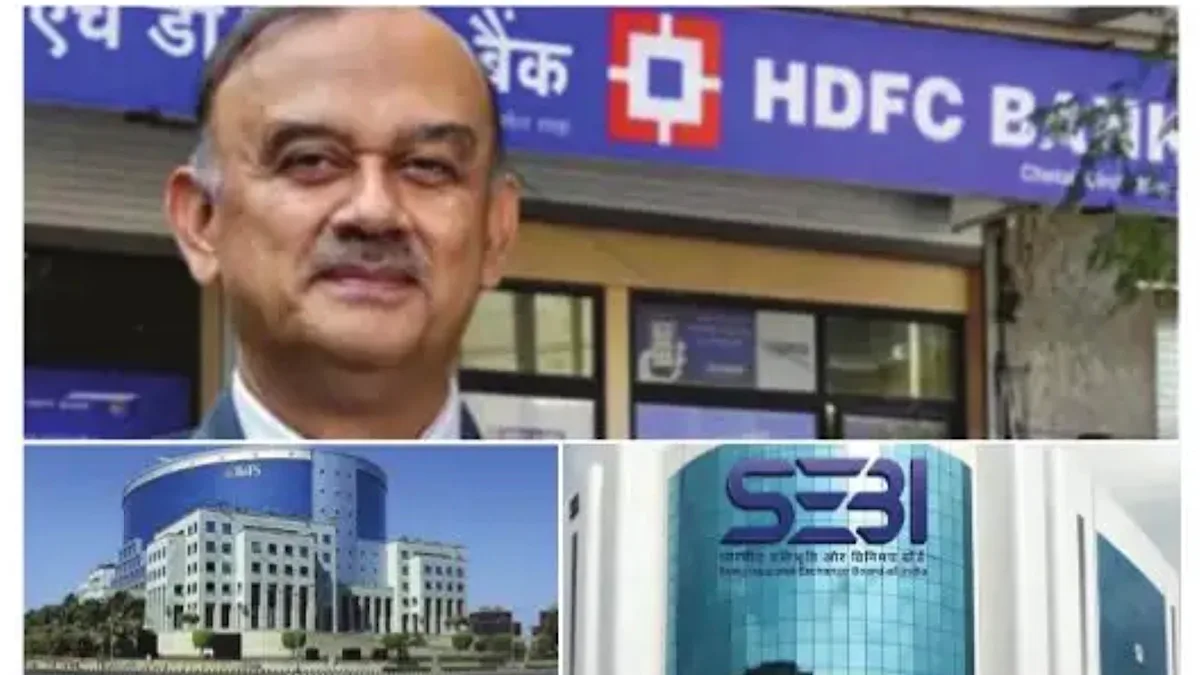
Photo:SNS
Resignation of the non-executive, independent Chairman of HDFC Bank Ltd. sent its share prices in a tailspin ~ declining by 5 per cent immediately, and reaching a sixteen year low within a fortnight. Apparently, the former Chairman spooked markets by his ultra-brief resignation letter wherein he cryptically observed: “Certain happenings and practices within the bank that I have observed over last two years, are not in congruence with my personal Values and Ethics.
This is the basis of my aforementioned decision (resignation).” No amount of clarifications from HDFC Bank itself, or even RBI, could stem the downward price spiral of HDFC shares, because in the absence of details, investors feared the worst. The resigning Chairman ~ an IAS officer in his previous avatar, who was in his present office for more than five years ~ pointedly declined to elucidate his concerns. Corporate grapevine has attributed his resignation to an ego clash with the Managing Director, alleging disagreements on a host of issues. Investors, who have lost heavily, are at a loss to understand, firstly, as to why the Chairman resigned abruptly, without specifying any reason, and secondly, why the Board of Directors had not even discussed the contentious issues hinted at in the Chairman’s resignation letter.
Advertisement
Independent Directors (IDs), the class of directors to which the former Chairman belonged, have no material relationship with the company, its executives, or its daily operations, hence IDs are expected to ensure unbiased decision-making, mitigate conflicts of interest, and impartially monitor management and financial reporting. One can say that IDs are appointed to provide transparency, accountability, ethical conduct, and boost investor confidence by their objectivity and oversight – tasks in which the ex-Chairman pointedly failed.
Advertisement
The Companies’ Act 2013, lays down that one-third of directors of every listed company should be Independent Directors; additionally, through Listing Obligation and Disclosure Requirements (LODR), SEBI has mandated that one-half of directors should be IDs in case the MD also functions as the Chairman, or is related to any of the promoters. It was hoped that the presence of a sizable number of IDs on the Board of Directors would ensure good corporate governance. However, this seldom happens; contrary to what is public knowledge now, no disagreements were noted in the minutes of Board meetings of HDFC Bank; thus, it would appear that minutes of board meetings were not faithfully recorded – the first requirement for good corporate governance.
The commendable intention behind having a significant presence of IDs on company boards was derailed by bureaucrats ~ who saw independent directorships as a gravy train for their retired colleagues, and themselves, after retirement, since all companies pay substantial amounts as sitting fees to IDs, with some companies also paying commission to IDs. Presently, retired bureaucrats hog most independent directorships in Public Sector Undertakings, with a substantial presence in private sector companies also. The earlier requirement of passing an examination in Corporate Law and Practice for independent directors was waived for mid-level and top-level bureaucrats.
Thus, many of the present crop of IDs, are not aware of their rights and responsibilities, and sad to say, most of such IDs blindly toe the management line ~ provided the management panders to their massive egos ~ contributing little to the improvement of corporate governance. Another category of IDs are famous and well-recognised faces, who are taken on board for their brand value, but who do not have the time and inclination to involve themselves with the affairs of the companies they are associated with.
No wonder, with such kinds of independent directors, the purpose of having IDs on company boards is often lost. As of today, the aggregate market capitalisation of 593 top Indian companies stands at a massive Rs.357 lakh crore, with Reliance Industries Limited heading the list at Rs.19 lakh crore. Controlling such humongous capital, sometimes dishonest managers are tempted to line their pockets at company expense. Since company funds belong to shareholders, elaborate rules have been framed to ensure good corporate governance – so that investors’ money remains secure. However, the enforcement of such rules leaves much to be desired; till the scam is on a small scale, like booking personal expenses to company accounts, or routing CSR funds to NGOs of directors’ relatives, no one ever complains.
Larger scams lead to resignations, typically ‘on health grounds’ or ‘for better opportunities,’ but seldom does a director’s misfeasance come out in the open. The IL & FS scandal of 2018, amply demonstrated what damage a corrupt management may cause, even to unrelated entities, and what happens when principles of corporate governance are not observed. To recapitulate: Infrastructure Leasing & Financial Services Ltd (IL&FS), promoted by Central Bank of India, HDFC Ltd, and the Unit Trust of India, was a systemically significant Core Investment Company, which provided loans and advances for infrastructure development.
At the time of going under, it was mostly developing infrastructure, instead of financing it, and was engaged in diverse businesses, encompassing energy, transportation, and finance sectors through 302 subsidiaries. IL&FS had assisted in developing and financing projects worth around 1.8 lakh crore, and its transportation division was constructing approximately 14,000 lane kilometres, in over 30 projects. IL & FS was being managed by a triumvirate of professional experts with roots in IIM(A) and other premier institutions, and had five most respected professionals as Independent Directors.
Also, 46 IAS officers, serving and retired, sat on the boards of various IL&FS group companies. The reason for the inability of IL & FS to repay its debt was simple ~ it had taken short-term loans for long-term projects. The failure of the talented boards of IL & FS and its subsidiaries to detect this patent anomaly and correct its business model defies understanding. What followed was even more ignominious; manipulation of financial statements by IL & FS management to show non-existent profits and payment of outrageously high remuneration to managerial personnel. Sadly, account books of IL & FS consistently passed muster by RBI, and some renowned auditors. Also, till the last IL & FS had top credit ratings by all agencies ~ pointing to deft ‘management’ by the earlier IL & FS Board. ncidentally, the new management has filed a suit for recovery of excess remuneration of Rs.187 crore, from the old management. The total outstanding debt of IL & FS and its subsidiaries was Rs.99,000 crore, after eight years the new management has set a target for recovery of Rs.61,000 crores – a significant loss for the public.
The IL & FS crisis immediately precipitated a severe financing drought, causing a liquidity crisis in the NBFC and corporate sectors, leading to the demise of several large and small corporations, including DHFL and Reliance Anil Ambani groups. SEBI, mandated to regulate both corporates and the securities market, more often than not, fails to prevent such incidents. Vested with legislative, quasi-judicial and quasi-executive powers, SEBI has the power to act, but often fails to act in time. It does not help that SEBI tries to regulate every possible aspect of corporate functioning, which results in a heavy compliance burden on companies, excess paperwork, and taking away focus on issues important to investors.
The Justice Sapre Committee, appointed by the Supreme Court, to probe allegations made by Hindenburg Research against the Adani Group, noted:
* There was a need to consider if an abundance of disclosures, mandated by SEBI, overwhelms investors with data, causing them to miss essential information for decision-making.
* SEBI should prioritize the quality and relevance of information provided rather than just the volume.
* SEBI could better achieve its regulatory goal by more focused enforcement, implying that SEBI should concentrate its efforts on “timely and sharp action in a few large and complex cases” rather than numerous smaller ones. To avoid repetition of IL & FS, and HDFC episodes, good corporate governance should be the topmost priority for SEBI. For this purpose, the institution of independent directors needs strengthening; firstly, by having domain experts as IDs, and secondly, by thoroughly familiarising prospective IDs with the nuances of corporate functioning.
Also, the performance of IDs should be closely monitored, and their concerns should be noted seriously by SEBI. Finally, it is the quality of leadership of a company (true for a country also), that determines its worth. As Mmanti Umoh, the Nigerian polymath, education psychologist, and management consultant had observed: “You can’t leave a legacy by appointing convenience over competence, true impact is built on courage, discernment, and the right people in the right seats”.
(The writer is a retired Principal Chief Commissioner of Income-Tax)
Advertisement